Partial Grouting of Block Walls
By Muhammad Adnan, PEC Registered Engineer (Software) · Published · Updated · About TrustTheCalcs
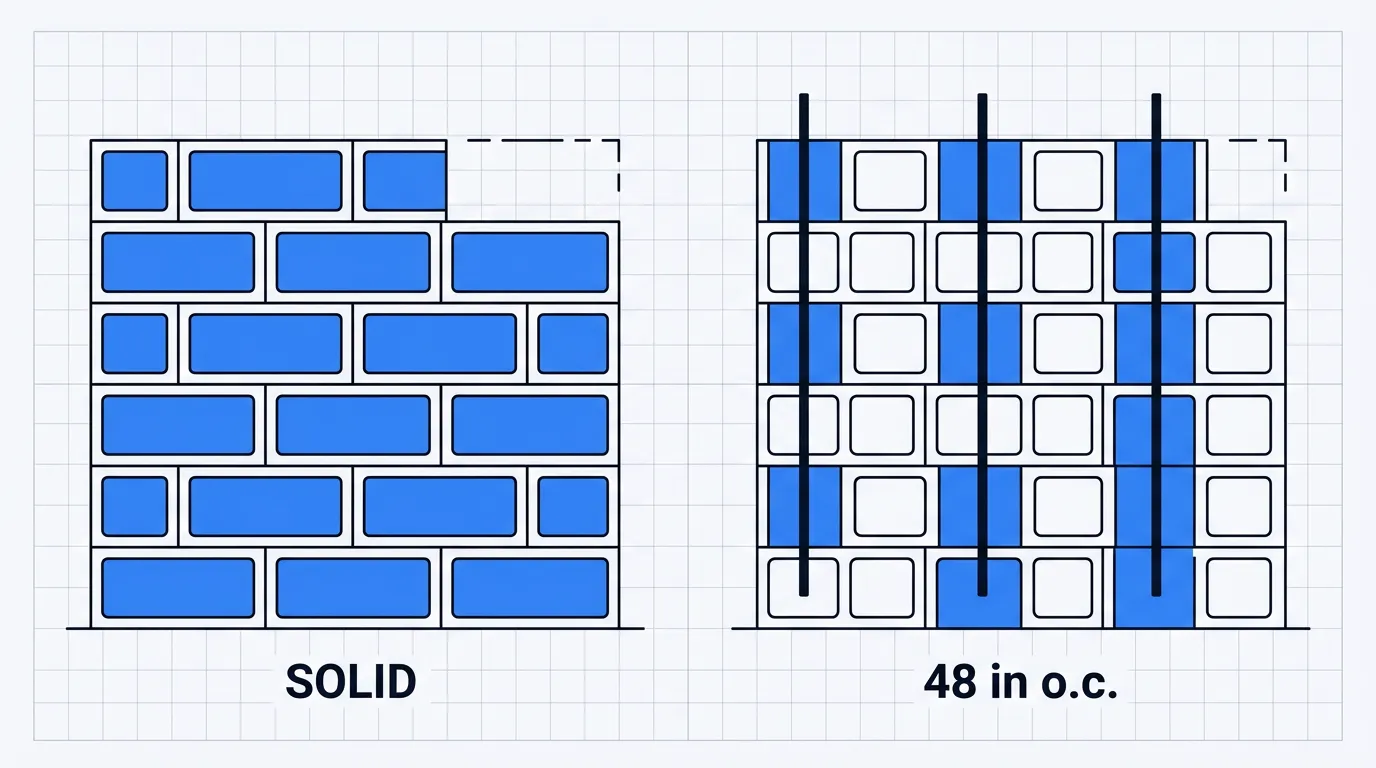
If one input decides whether your grout order is right or wildly wrong, it is grout spacing. A block wall grouted at every cell needs several times the grout of the same wall grouted every few feet. And pricing a partially grouted wall as if it were solid is one of the most expensive mistakes on a masonry takeoff. Before we get into why, you can see the effect for your own wall in the concrete block fill calculator: change only the grout spacing and watch the cubic yards move, with the CMHA source shown next to the result.
What "partial grouting" actually means
A hollow concrete block wall has continuous vertical cells. In a fully grouted wall, every cell is filled solid. In a partially grouted wall, which is how most reinforced masonry is actually built, grout and vertical rebar go only into cells at a specified spacing, and the cells in between are left hollow. The spacing is written on the structural drawings as an on-center dimension: "grout 48 in o.c." means a filled, reinforced cell every 48 inches, with hollow cells between.
That spacing is an engineering decision based on the loads the wall carries. Your job on the estimating side is to grout at the spacing specified, not to fill solid because it feels safer, and not to guess.
The spread: 5.9× from solid to 48 in o.c.
Here is how the grout quantity for an 8 in wall collapses as the spacing widens, taken directly from the CMHA grout table:
| Grout spacing (8 in wall) | ft³ per 100 ft² | vs. all cells |
|---|---|---|
| All cells (solid) | 36.1 | 1.00× |
| 16 in o.c. | 18.1 | 0.50× |
| 24 in o.c. | 12.1 | 0.34× |
| 32 in o.c. | 9.1 | 0.25× |
| 48 in o.c. | 6.1 | 0.17× |
Solid grouting (36.1 ft³) is 5.9× the volume of 48 in on-center grouting (6.1 ft³) for the same 8 in wall.
Read the endpoints: an 8 in wall grouted at all cells takes 36.1 ft³ per 100 ft² of wall, while the same wall grouted at 48 in on center takes just 6.1 ft³, a 5.9× difference. The values in between scale about the way you would expect: fill half as many cells and you need roughly half the grout. This is why spacing dominates the order. Price a 48-in-o.c. wall as if it were solid and you have over-ordered grout by nearly six to one, thousands of dollars of material on a large job, sitting unused because a single dropdown was set wrong.
A worked comparison
Put real numbers on it. Take a 20 ft × 8 ft wall, 160 ft², built from 8 in block. Grouted solid, at 36.1 ft³ per 100 ft², it needs about 57.8 ft³ of grout, a little over two cubic yards. The same wall grouted at 48 in on center, at 6.1 ft³ per 100 ft², needs about 9.8 ft³, roughly a third of a cubic yard. That is the difference between ordering two-plus yards of ready-mix grout and buying a handful of bags. Both walls can be perfectly correct; the only thing that changed is which cells the drawing says to fill. Get that dropdown wrong on a large elevation and the error compounds across every hundred square feet of wall.
Why it scales that way
The logic is simple once you see it. The CMHA figure is grout volume per unit of wall area. Solid grouting fills every cell along that area; wider spacing fills fewer of them, leaving hollow cells that hold no grout. Grout volume tracks the number of filled cells, and the number of filled cells is set by the spacing. There is no waste-factor magic hiding in the difference. It is just fewer cavities getting filled.
Because the relationship is close to linear in the number of filled cells, you cannot safely interpolate a spacing the table does not list. The calculator only offers the spacings that exist as real rows in the source table; it will not invent a value for a spacing in between. If your drawings call a spacing that is not a standard row, that is a question for the engineer, not for a spreadsheet guess.
Bond beams are always solid. And the table leaves them out
There is one part of a partially grouted wall that is never partial: the bond beam. A bond beam is a horizontal grouted course, typically at the top of the wall, at floor and roof lines, and above openings, running continuously through channel or knockout block, and it is filled solid along its entire length regardless of the vertical cell spacing. The horizontal steel in a bond beam ties the wall together, and grout has to be continuous for it to work.
Two things follow for your estimate. First, bond-beam grout is additional to the cell grout from the spacing table. You do not get to skip cell fill because you have a bond beam, and vice versa. Second, and this trips up a lot of takeoffs: the CMHA cell-grout table excludes bond beams and other horizontal grouted courses entirely. Its figures cover vertical cell fill only. You compute bond-beam volume separately, from the wall length and the block geometry, and add it on top. The block fill calculator does exactly this. It breaks bond-beam volume onto its own line so you can see it is not buried in, or missing from, the cell number.
How to order a partially grouted wall
Put it together in order:
- Wall area and thickness set the base figure from the table.
- Grout spacing, copied off the drawings, never assumed, scales it. This is the input that matters most.
- Bond-beam courses add their own solid volume on top.
- Waste covers spillage and overfill on the cell grout you are placing.
Then read the cubic-yard figure to order ready-mix grout, or the bag count to buy bags. Do this with the block fill calculator, sanity-check bags against the bag yield chart, and if you want the per-block foundation of these numbers, read how much concrete it takes to fill cinder blocks. More tools are on the masonry calculators hub.
Structural safety notice
This guide is general information for planning only and is not a substitute for a licensed structural or civil engineer. Do not rely on it for load-bearing, safety-critical, or code-compliance decisions.
How we source and correct figures: editorial policy.