Masonry & concrete
Masonry & Concrete Block Calculators
Every tool below shares one rule: the constant behind each number is named and shown. Start with what you are estimating.
Getting different answers elsewhere? Why Masonry Calculators Disagree sets out which basis each figure uses.
Calculators
Concrete Block Fill Calculator
LiveGrout volume, cubic yards, and bag count to fill CMU cells: every figure sourced.
Use this when
You are grouting some or all cells of a block wall and need volume plus bag count.
Cinder Block Calculator
LiveBlock count, courses, and waste from wall dimensions and openings.
Use this when
You need how many blocks to build a wall, minus its doors and windows.
Block Mortar Calculator
LiveBags or site-mixed batches of mortar from CMHA figures, face shell bedding.
Use this when
You need how much mortar to lay a block wall, in bags or ingredient volumes.
Retaining Wall Block Calculator
LiveBlocks, caps, base pad and gravel from your own block size, with the governing minimum named for each.
Use this when
You are building a segmental retaining wall and need block, cap, pad and gravel quantities with their sourced minimums.
Block Wall Cost Calculator
LiveYour local prices, our sourced quantities, so the total never goes stale.
Use this when
You are pricing a block wall or checking a contractor's quote with your own local material and labor rates.
Guides
All guides →How Much Concrete to Fill Cinder Blocks
The real per-block volume, and why published figures scatter 23-fold.
Read guide →Should You Fill Cinder Blocks With Concrete?
When filling earns its cost, when it is wasted, and what to fill with.
Read guide →Partial Grouting: Why Spacing Changes Your Order by 5.9x
Solid vs partial fill, read from the CMHA grout table.
Read guide →Mortar for Block Walls: Type N, S, M and O Compared
Which ASTM C270 type to use, what the standard specifies, and when code decides.
Read guide →Retaining Wall Cinder Blocks
Which block actually retains soil, how high you can go before a permit, common sizes and how much gravel goes behind it.
Read guide →What Drives Cinder Block Wall Cost
The four cost buckets, why labor dominates, and how to read a quote line by line.
Read guide →Reference
All reference →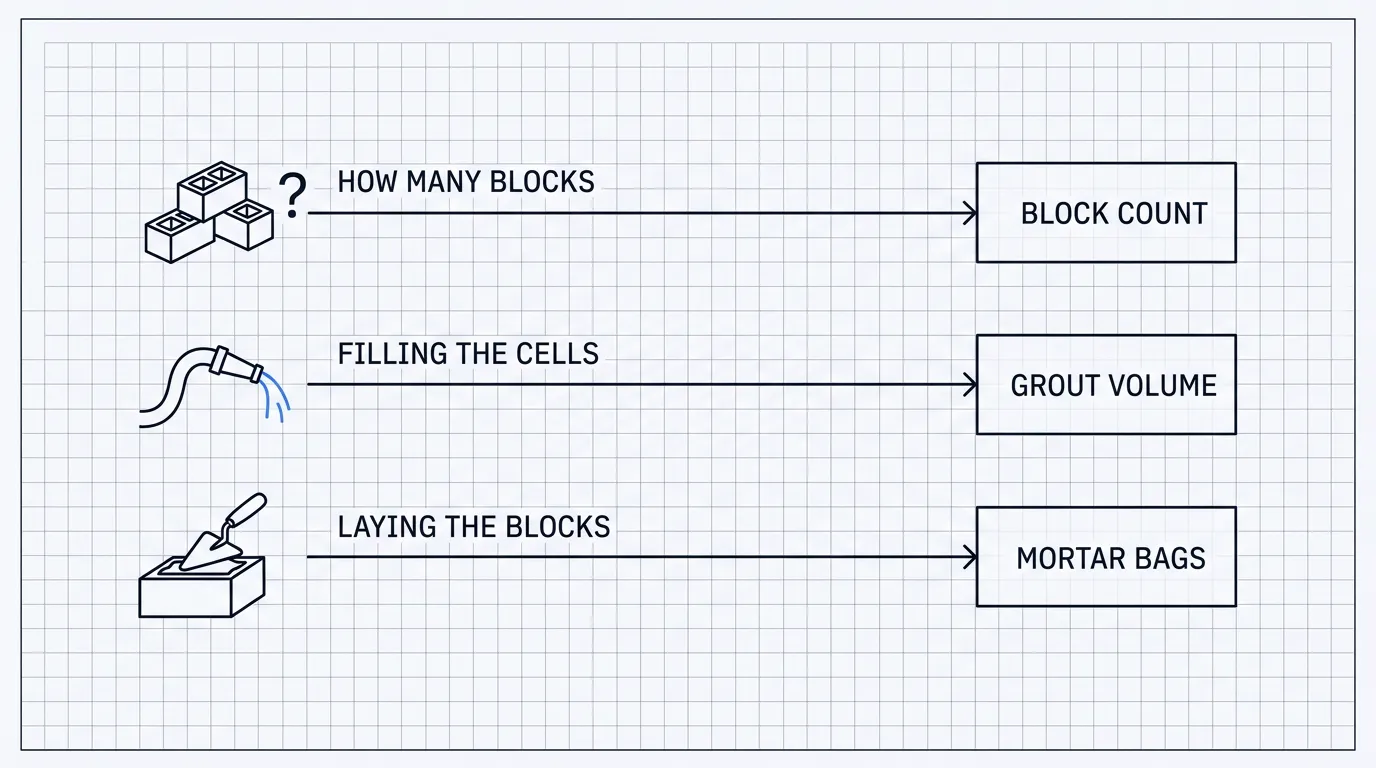
Which calculator do I need?
Three tools, three different jobs. Most block projects need more than one.
You are working out how many blocks to buy. Use the cinder block calculator. It takes wall length and height, deducts openings, and returns block count, course count and blocks per course. A conventional unit with an 8 by 16 inch face covers eight ninths of a square foot, which is why a wall takes 1.125 blocks per square foot before waste. Half high units double that to 2.25.
You are filling the cells with grout. Use the concrete block fill calculator. This is a different calculation from block count, and the single input that matters most is grout spacing. Filling every cell and filling only the cells that carry reinforcement are not variations of the same number, they are 5.9 times apart at 8 inch wall thickness.
You are laying the blocks and need mortar. Use the block mortar calculator. Mortar bonds the units, grout fills the cells, and the two are specified and ordered separately. Mortar quantity follows the block count and the bedding method, not the wall thickness.
Building a segmental retaining wall is its own job: the retaining wall block and gravel calculator works out blocks, caps, the base pad and the gravel backfill from your own block size. Pricing a wall is its own job too: the block wall cost calculator takes your local rates and our sourced quantities, because material prices vary by region and week and we do not publish numbers we cannot source. For what actually drives that bill, see the cost of a cinder block wall.
How these numbers are sourced
Every constant on this site is traceable to a named standard and displayed next to the result it produced.
Grout volumes come from CMHA TEK 09-04A, Table 2. Unit geometry and ASTM C90 minimum face shell and web thicknesses come from CMHA CMU-TEC-001-23, Table 2. Mortar quantities come from CMHA TEK 04-02A and, where a product is named, from that manufacturer's own published data sheet. Bag yields come from the QUIKRETE product data sheets.
No paywalled standard text is reproduced here. We cite and link, and where two legitimate sources disagree, both are shown rather than averaged into a single number that belongs to neither. The methodology page explains how each tool derives its result, and every sourced constant in the codebase is listed with its origin.
Common masonry estimating mistakes
Using actual dimensions for coursing. A nominal 8 by 8 by 16 inch block actually measures 7 and 5 over 8 by 7 and 5 over 8 by 15 and 5 over 8 inches. The missing three eighths of an inch is the mortar joint, and it is already inside the nominal figure. Course with nominal dimensions or the block count comes out wrong. See cinder block dimensions.
Assuming every cell gets grouted. CMHA Table 2 gives 36.1 cubic feet of grout per 100 square feet for an 8 inch wall with all cells filled, and 6.1 cubic feet at 48 inches on center. Ordering the first number for a wall specified as the second is a 5.9 times overbuy. See partial grouting.
Treating grout and concrete as the same material. Grout is specified at an 8 to 11 inch slump under ASTM C476 and TMS 602 so it flows into cells around reinforcement. Bagged concrete mix contains coarse aggregate and is too stiff to consolidate in a cell. See how much concrete to fill cinder blocks.
Specifying the strongest mortar available. Type M at 2,500 psi is not a safer default than Type S at 1,800 psi. Each is specified for a different exposure, and compressive strength is not the property that governs how a mortar performs in a wall. See mortar for block walls.
Quick answers
How many blocks are in a square foot of wall?
1.125 for any unit with a conventional 8 by 16 inch face, because that face covers eight ninths of a square foot. Half high units with a 4 by 16 inch face give 2.25 per square foot. Both figures are before waste.
How much grout does one block hold?
About 0.321 cubic feet for an 8 inch unit on the CMHA estimating basis, which includes a waste allowance. The bare cell geometry at ASTM C90 minimum face shell and web thickness works out to 0.302 cubic feet. Order to the first, understand the second.
How many blocks does a bag of mortar lay?
16 on the CMHA estimating basis for an 80 pound bag of preblended mortar. Manufacturer data sheets publish their own conservative figures: QUIKRETE lists 13 and Sakrete lists 12. All three are correct on their own basis. Order to the bag you are buying.
Does block width change how much mortar I need?
Not on the CMHA basis, which publishes one figure across widths for face shell bedding. Manufacturer tables do vary with width, because ASTM C90 sets a deeper minimum face shell on wider units: 0.75 inch at 4 inch nominal, 1.00 inch at 6 inch, and 1.25 inch at 8 inch and above.